Numblock Factory Block Puzzle
Voxel Cube GamesBoard
4.87.00 Reviews
- Version
- 1.0.11
- Installs
- 10.00K
- Age Rating
- Everyone
Screenshots
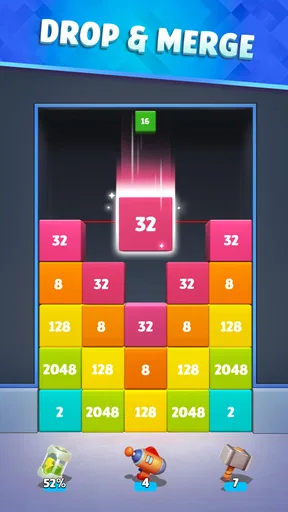
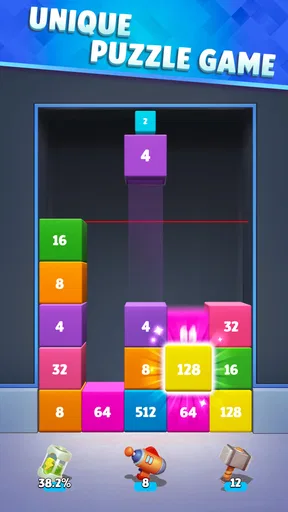
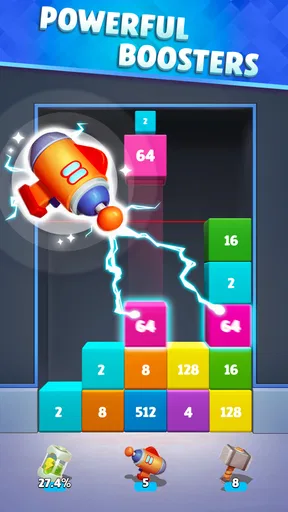
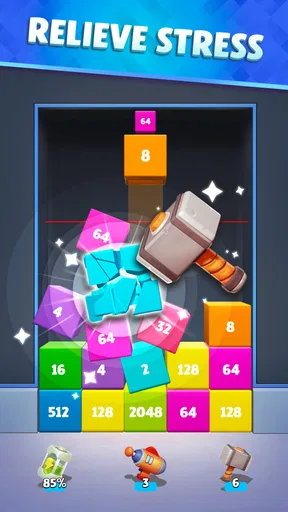
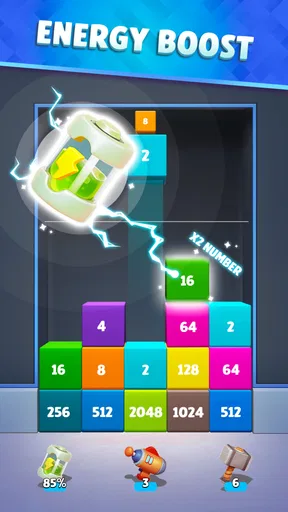
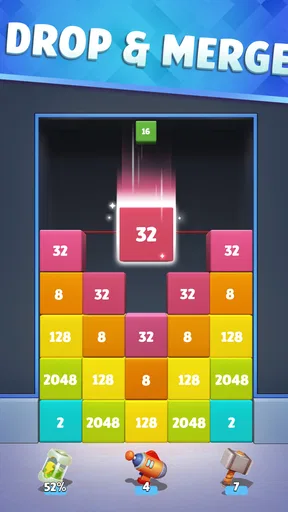
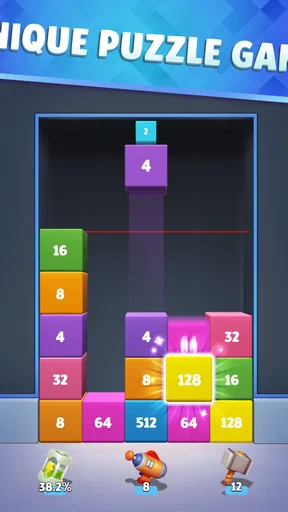
Our Review of Numblock Factory Block Puzzle
 Analysis by Appyee
I went into Numblock Factory Block Puzzle expecting a simple number game, but its three-dimensional presentation gives the familiar merge idea a more hands-on feel. The basic task is easy to understand: combine matching number blocks so they become larger blocks, then keep making sensible choices as the available space becomes harder to manage. That makes it approachable immediately, while still leaving room for mistakes when I rush.
This is a free board game from Voxel Cube Games, rated for Everyone. It is available for Android devices running at least Android 7.0, and the current release is version 1.0.11. The game has built a 4.8 average from around 150 ratings and has passed 10 thousand installs, which suggests that its compact, accessible style has found a receptive audience without making it feel like a huge mainstream production.
How I Decide Whether This Puzzle Is a Good Fit
When I decide whether this puzzle deserves a place on my phone, I look beyond the first satisfying merges and ask whether its careful, spatial choices still suit the breaks I actually have. I’ll focus on how to judge that fit for your own habits, including what to notice in a short trial before deciding whether to keep playing.
The first question is what kind of thinking you enjoy
The most important decision is whether you want a board game that rewards short, careful moves rather than long explanations or complicated rules. Numblock Factory is a good match if you like watching a board develop, spotting a useful merge, and deciding whether to act now or preserve room for a better combination later. I found the appeal strongest in short sessions, when I wanted something more engaging than passive scrolling but not a game that demanded a large time commitment.
The 3D block layout changes how I read the board. In a flat number puzzle, the next move can often be judged by looking along rows and columns. Here, the blocks feel more like objects arranged in a small space, so I pay attention not only to their values but also to how the whole arrangement is forming. That extra visual layer is the main reason this does not feel like a completely interchangeable number-merging game.
I would also consider how patient you are with gradual progress. The opening moves are straightforward, but the interesting decisions arrive when a convenient merge competes with a move that keeps several future options alive. My practical tip is to avoid merging the first available pair automatically. Before touching a block, I look for the move that leaves the most open room and the fewest isolated values. That habit matters more than trying to play quickly.
What makes the board satisfying
The core loop is built around accumulation. Small blocks are useful because they can be combined, but they also occupy space and can make the board awkward if I create them without a plan. Larger blocks feel rewarding because they represent several earlier decisions, not just one tap. I enjoy that sense of building something gradually, especially when a crowded position suddenly opens after a well-timed merge.
A useful way to approach a difficult board is to think in terms of preparation rather than immediate reward. I try to keep compatible values within reach while avoiding a layout where one block becomes stranded behind unrelated pieces. This is a small but important strategic distinction: the best move is not always the one that produces the biggest block right away. Sometimes preserving a simple pair is more valuable than making a larger block and losing flexibility.
That approach also gives the game some replay value. Even when the rules remain simple, I can change my priorities from one attempt to the next. I might focus on clearing space, building a particular chain of merges, or simply surviving longer without creating a messy cluster. The game does not need a large rulebook to offer these different styles of play.
Why the 3D presentation matters
The three-dimensional design is not just decoration from my point of view. It affects how quickly I understand the state of the board and how carefully I make each decision. Blocks have a physical presence that makes the growing structure easier to follow, but that can also make a busy position require more attention than a very clean two-dimensional grid.
For that reason, I recommend playing with a deliberate rhythm. I pause briefly after every meaningful merge and check what the new arrangement has changed. This is especially helpful when a single combination creates a larger block that alters the balance of the board. Rushing can turn a manageable position into a poor one simply because I was looking at the immediate result instead of the next two possibilities.
The visual style should appeal to players who like tidy, object-based puzzle boards. If you prefer bold story scenes, character progression, or a constant stream of new mechanics, the presentation may feel restrained. Its strength is focus: the blocks and their relationships stay at the center of the experience.
Where it fits into an ordinary day
I can see myself using this during a short break, while waiting for an appointment, or at the end of the day when I want a game that does not require learning a complicated system. A typical session would be to open it, make a few cautious merges, and stop after reaching a natural pause. The number-based structure makes it easy to return after a gap because the objective is clear as soon as the board appears.
It also works for people who want a quiet solo board game rather than a competitive experience. I would not choose it when I am looking for social play, a story campaign, or a deep collection system. I would choose it when the simple act of organizing a growing board sounds relaxing but still gives me enough decisions to stay involved.
Where this game wins against familiar alternatives
Compared with classic match-three puzzles, this game puts more weight on planning the position of values instead of simply reacting to a colorful set of matches. Match-three games often reward quick pattern recognition and chain reactions; Numblock Factory is more deliberate. I spend more time considering the consequences of a merge and less time scanning for a large visual combo.
Compared with traditional flat number-merging games, the 3D block arrangement gives this version a distinct identity. The numbers remain the main language of the puzzle, but the blocks feel more concrete and spatial. That is a worthwhile advantage for anyone who has tried standard number grids and wants the same general satisfaction in a less familiar presentation.
Compared with classic tabletop board games, it is much easier to start and stop. There is no setup, no opponent to organize, and no physical pieces to arrange. The trade-off is that it does not offer the social negotiation, bluffing, or long-term planning that makes games such as chess, checkers, or tile-based tabletop titles compelling. It is best understood as a compact digital puzzle, not a replacement for a full board-game night.
The small habits that improve a run
My first practical recommendation is to preserve space before chasing size. A large block is satisfying, but a board with no room for the next useful combination is usually less healthy than a board with several modest blocks arranged sensibly. I also try to avoid scattering similar values across awkward positions. Keeping potential partners reasonably close makes later decisions easier and reduces the chance that a valuable block becomes useless.
My second tip is to treat every new placement as a future problem, not merely a current opportunity. Before merging, I ask where the resulting block will sit and what it might block afterward. This is particularly useful in a 3D layout, where the visual shape of the arrangement can hide a poor follow-up move. A few seconds of checking often saves an entire run.
My third tip is to use short sessions as practice rather than judging the game by one unlucky board. The early part of a run teaches how quickly the space becomes crowded and which arrangements are easiest to recover. Once I stopped trying to force a perfect chain every time, the game became more enjoyable. I could experiment with safer layouts and learn which mistakes were genuinely costly.
Where another type of puzzle may fit better
Numblock Factory is not the right choice for every puzzle player. If you want a fast, reflex-heavy game, a match-three title may feel more energetic. If you want a carefully balanced competitive board game with an opponent, this solo number puzzle will not provide that kind of tension. If you want a narrative adventure, character upgrades, or a large sense of progression, its focused merge board may seem too narrow.
It may also be a weaker fit for someone who dislikes spatial clutter. The same 3D presentation that gives the game personality can make a crowded board require more visual concentration. Players who prefer extremely minimal interfaces may find a conventional flat grid easier to read at a glance. In that case, the alternative is not necessarily better overall; it is simply better aligned with a preference for immediate visual simplicity.
The game is free to install, which makes trying it low-risk, but it includes in-app purchases ranging from $0.99 to $94.99 per item. I would keep that in mind if I am choosing a game for a child or for a device where spending needs to be tightly controlled. The Everyone rating describes the intended age suitability, but the presence of optional purchases is still a practical consideration for families.
What switching to it really involves
The cost of switching from another number puzzle is mostly a change in visual habits. The underlying idea of combining values is familiar, so I did not need a long learning period. The adjustment comes from reading the blocks as a three-dimensional arrangement and accepting that a move can be visually attractive while strategically unhelpful.
There is also a small mental shift from chasing immediate combinations to managing the board as a limited workspace. Players coming from quick match-three games may need to slow down. Players coming from flat merge games may need to look more carefully at the shape and position of the blocks. Once that adjustment is made, the controls and objective are easy to grasp.
I would not switch expecting a completely new puzzle genre. The appeal is refinement and presentation rather than a dramatic reinvention of number merging. That is good news if you already enjoy the basic loop and want a 3D interpretation. It is less convincing if you are bored by merging itself and are hoping the visual change alone will transform the experience.
Value, accessibility, and everyday practicality
Because the game is free, I can test its central loop without committing money first. That matters for this type of title: the real question is whether the board remains interesting after the first few attempts. In my experience, the answer depends on how much I enjoy optimizing space and repeating a compact decision cycle. The game has enough structure to support that, but it is not designed to satisfy every kind of long-term player.
The Everyone age rating makes it an approachable recommendation for a broad audience, especially families looking for a simple number game. I would still explain the purchase settings before handing it to a child, since optional item prices can be substantial at the upper end. For adults, the main value is convenience: it is an accessible board-style distraction that can fit into spare minutes.
The developer, Voxel Cube Games, has kept the concept focused rather than surrounding it with unrelated genres or a heavy narrative premise. That focus helps the game communicate quickly. It also means the experience stands or falls on the quality of its merge decisions and on whether the 3D board stays readable when it becomes busy.
My recommendation for different players
I recommend giving Numblock Factory a try if you enjoy number puzzles, prefer thoughtful moves over rapid tapping, and like the idea of arranging physical-looking blocks in a compact 3D space. It is especially suitable for short solo sessions, casual players, and anyone who wants a board game that can be understood almost immediately but still rewards restraint.
I would skip it if your priority is multiplayer competition, a story, elaborate progression, or constant novelty. I would also choose a simpler flat number grid if visual clarity matters more to me than the tactile 3D presentation. Those are not flaws in the game so much as clear boundaries around what it is trying to do.
After spending time with it, my view is that the strongest reason to install it is the combination of familiar merging and spatial decision-making. The best experience comes from treating every merge as a board-management choice, not just a way to make a bigger number. That mindset gives the simple rules more depth and helps the game feel purposeful instead of repetitive.
For a free board game with an Everyone rating, a 4.8 average, and a current version of 1.0.11, it makes a convincing case as a low-commitment puzzle to keep available for spare moments. I would not call it a universal replacement for every number or board game, but I would recommend it to a friend who wants something calm, compact, and quietly strategic. Its 3D identity gives the familiar formula a useful twist, while its limitations make the recommendation clearest for players who genuinely enjoy careful merging and space management.
Verdict
Strengths of Numblock Factory Block Puzzle
- Simple controls make it easy to learn within minutes.
- Short rounds suit quick play sessions on mobile.
- Colorful visuals and satisfying block-placement feedback.
- Works well as a casual, low-pressure puzzle game.
- Increasing challenges can help maintain long-term interest.
Limitations of Numblock Factory Block Puzzle
- Some levels may feel repetitive after extended play.
- Progress can become frustrating when available blocks are unfavorable.
- Small screen layouts may make precise placement harder on phones.
- The game may offer limited variety beyond its core puzzle mode.
- Ads or optional purchases may interrupt the playing experience.
Similar Picks in This Category
View All
Ludo King®
Gametion4.1

Ludo
Yarsa Games4.6

Tile Master® - Matching Game
Higgs Studio3.6

Checkers Online
CC Games4.6

Dominoes
Loop Games4.7

Chess
Chess Prince4.6
Frequently Asked Questions
What is Numblock Factory Block Puzzle?
Numblock Factory Block Puzzle is a number-based puzzle game that combines block placement with simple arithmetic and strategic planning. Players arrange numbered blocks, create combinations, and try to achieve higher values or scores while keeping the board under control. Its factory-style presentation gives the game a distinctive theme, while the core gameplay is designed for short, relaxing sessions as well as longer attempts to improve your personal best.
How do you play Numblock Factory Block Puzzle?
The main objective is to place the available numbered blocks on the board in a way that creates useful matches or combinations. Depending on the current pieces, you may need to plan several moves ahead instead of filling empty spaces immediately. Clearing blocks gives you more room and helps maintain your run. The game is easy to understand at first, but later decisions require careful positioning, number management, and efficient use of limited space.
Is Numblock Factory Block Puzzle suitable for beginners?
Yes. Numblock Factory Block Puzzle is generally accessible to beginners because its basic controls and block-placement mechanics are straightforward. New players can learn by experimenting with different arrangements, while the increasing challenge provides room to develop better strategies. It is also suitable for casual players who prefer games that can be played in short bursts. However, achieving high scores may require patience, forward planning, and learning from unsuccessful rounds.
Can Numblock Factory Block Puzzle be played offline?
The core puzzle experience may be playable without a constant internet connection, which makes it convenient for travel, waiting rooms, or other situations where mobile data is unavailable. However, certain features may still depend on connectivity, including advertisements, online services, updates, leaderboards, cloud-related functions, or optional purchases. Availability can vary by version and device, so it is best to check the game's current store description and test the main gameplay after installation.
Is Numblock Factory Block Puzzle free to download?
Numblock Factory Block Puzzle may be available as a free download, but free access does not necessarily mean that every feature is completely unrestricted. The game can potentially include advertising, optional in-app purchases, extra lives, boosters, cosmetic items, or other paid conveniences. Before downloading, review the Google Play or App Store listing for the latest pricing information, supported devices, permissions, and any purchase conditions. Parents should also check spending controls if children will play.
Play our best games!


